.webp)

Back to all
Unify Montrose Faced Its First Crisis

Joshua Chittum
Jan 6, 2026
Aug 27, 2026


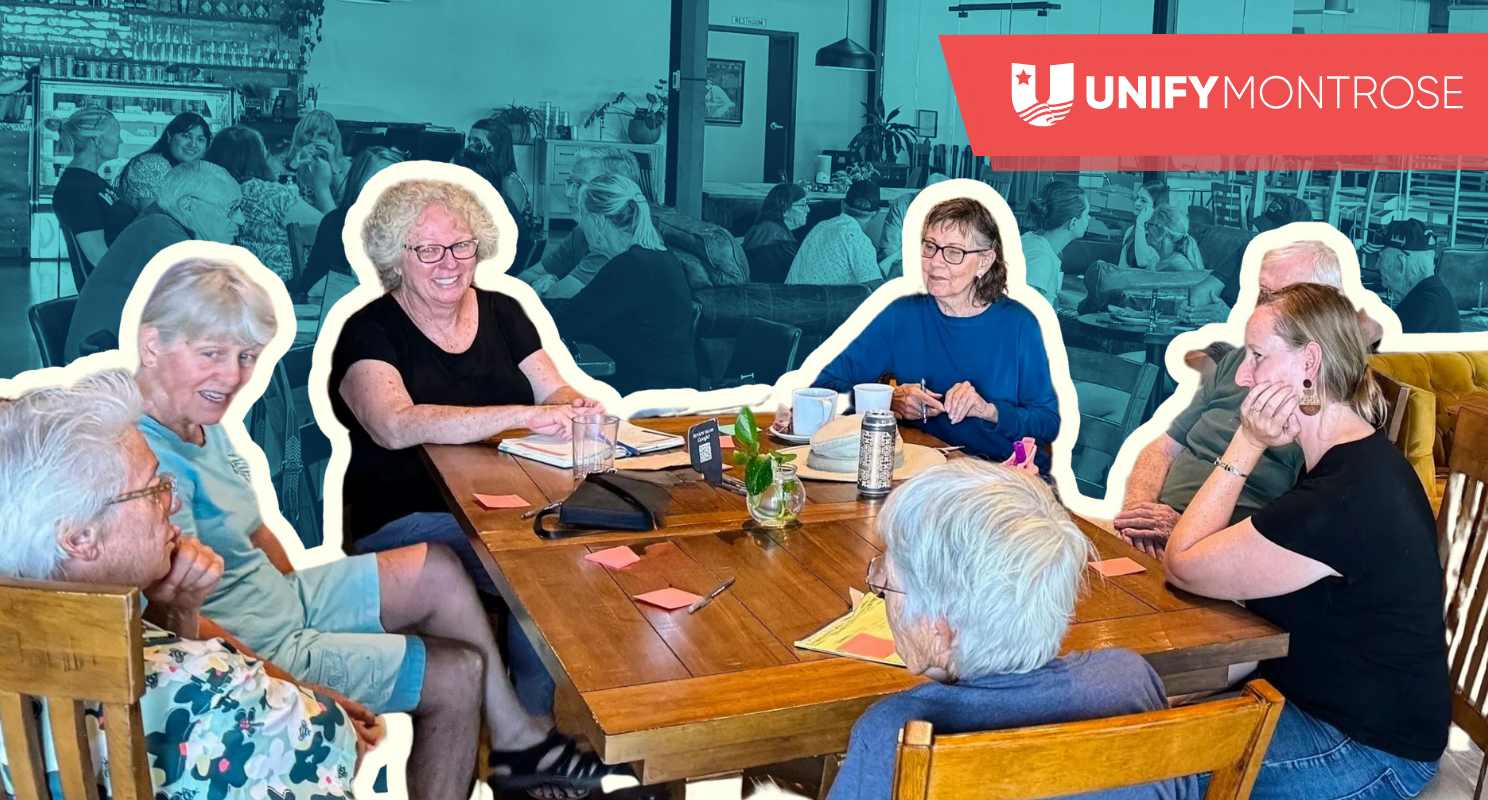
In 2023, we launched a pilot Civic Assembly in Montrose, Colorado, a small town on the Western Slope of the Rockies. We didn’t know what would happen, but our goal was clear: we wanted to test whether everyday residents could come together across their differences, learn from one another, and tackle a local challenge as a community.
To our surprise, Montrose didn’t just participate in the project; they took ownership of it. After our pilot wrapped, local volunteers created their own 501(c)(3), Unify Montrose, to continue the work we’d started with them.
For a while, Unify Montrose quietly put in the work to build its organizational capacity. It began hosting regular gatherings for people interested in addressing local problems in a different way. It worked with stakeholders to explore potential solutions to local homelessness during winter weather. And it introduced the concept of deliberation to a group of local students who wished to reach a consensus on after-school activities.
Then the first real test arrived.
A local political fight caught fire, and some residents assumed that Unify Montrose was aligned with one side of the argument–or worse yet, instigators of the fight. In fact, the organization hadn’t taken a position at all, but that didn’t matter. In a climate where people everywhere are sorted into “friend” or “foe,” the perception of bias alone posed a serious risk.
For a moment, it looked like everything Unify Montrose had built might crumble. But how they responded made all the difference.
Instead of retreating, Unify Montrose doubled down on a principle that had defined their success from the beginning: openness.
Unify Montrose leaders increased public invitations to community gatherings, encouraging people to come see the work firsthand. No filter, no rumor mill. And they sat down with worried community members and local leaders, not to argue, but to listen and explain the mission clearly and calmly.
These weren’t debates. They were conversations…the kind where people actually take a breath, ask questions, and hear one another.
Listening doesn’t magically change every mind. It does something more valuable: it preserves relationships, builds trust, and creates shared facts. In other words, it lays the foundation for the next conversation.
In time, the larger political conflict went to the ballot box. Not everyone liked the result, but people accepted it, peacefully.
And through it all, Unify Montrose remained standing. The organization not only weathered the moment, it strengthened its reputation as a place where disagreement is handled with curiosity, not combat.
Enjoyed this article?
Sign up for our newsletter to join the thousands of Americans who are making a difference, and then consider sharing it.
a little bit about us

Unify America is a nonpartisan nonprofit on a mission to replace political fighting with problem-solving. We leverage technology and games to reduce political polarization and teach civic and problem-solving skills so Americans can work together to reach our shared goals. Founded in 2020 by Harry Nathan Gottlieb (founder of Jellyvision and Jackbox Games), Unify America builds interactive experiences to teach and master critical civic skills across cultural, political, racial, geographic, and religious differences.

You might also be interested in...
.png)
News & Announcements
Five Colleges Selected for First-of-its-Kind Effort to Connect Civic Learning to Workforce Readiness
A new Unify America pilot connects civic learning to the durable skills employers say new grads need.
.png)
Unify America Team
Sep 11, 2026
Sep 10, 2026

Campus & Higher Ed
Can Two Strangers Actually Have a Real Conversation About the Big Stuff?
Three students share what it's really like to talk politics with a stranger in the Civic Gym.

Layne Turci
Aug 27, 2026
Aug 27, 2026

Perspectives
American Ideals Day - A Reflection
A year of hope: from Akron's Civic Assembly to Civic Gym growth, ordinary people prove progress comes from staying in the conversation.

Harry Nathan Gottlieb
Aug 27, 2026
Jul 1, 2026


We use cookies to optimize our website and your experience with Unify America. But, like our democracy, you're in control. View our Privacy Policy for more information.

Privacy is important to us, so you have the option of disabling certain types of storage that may not be necessary for the basic functioning of the website. Blocking categories may impact your experience on the website. More information