

Back to all
Practice Field to Game Day: Why Durable Skills Need Low-Stakes Practice

Fabrice Braunrot
Nov 16, 2026
Nov 16, 2026


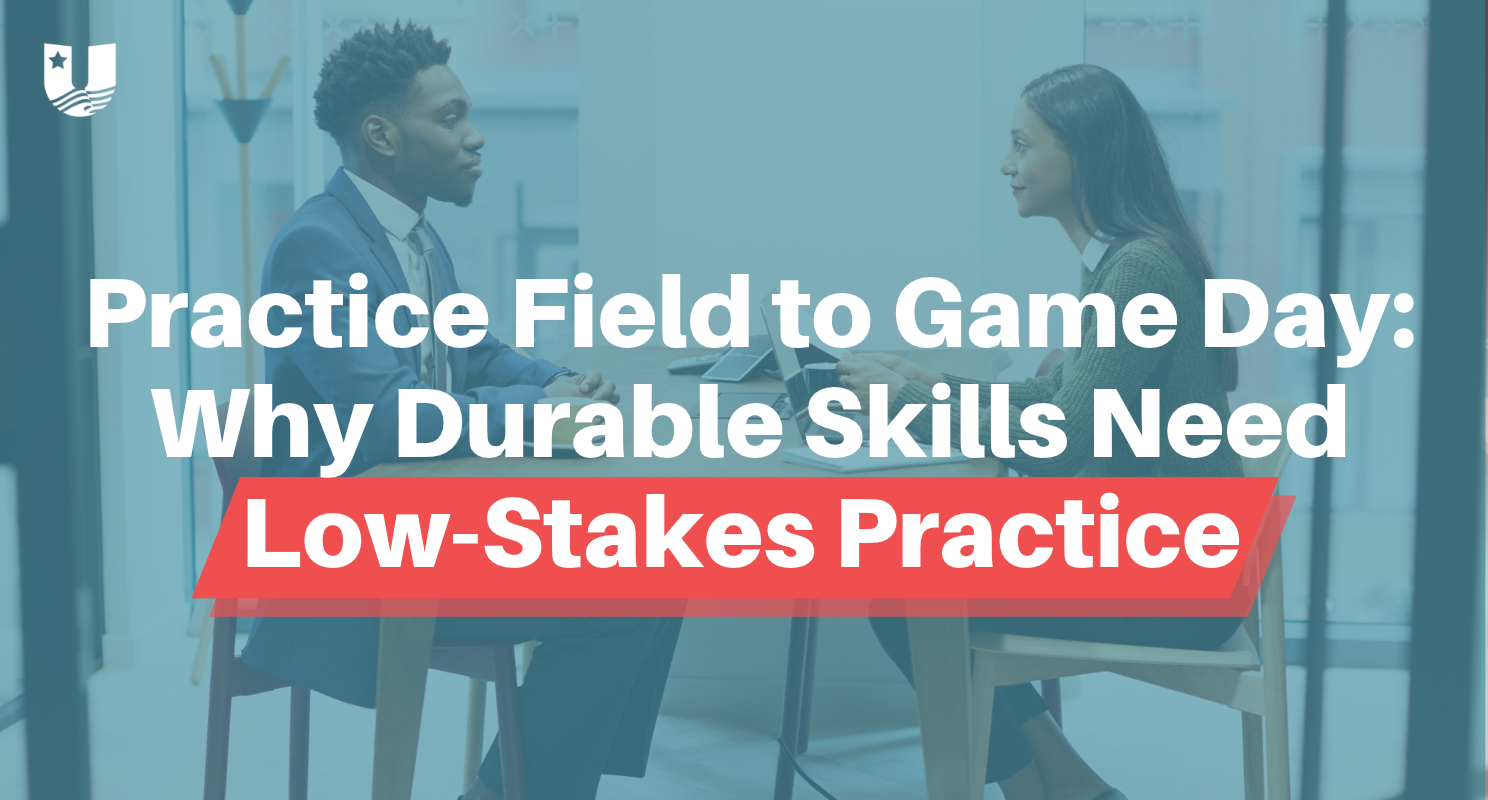
A compelling part of the training course we ran at JPMorgan was when I would play “the banker” with a colleague who played “the prospect” for our class. I would start by asking a question, the answer prompted another question and then another and another. Each time more layers peeled away and soon everyone could see how and what my “prospect” thought and had a good idea of who they were. I would then ask the class, “When will someone stop answering your questions about themselves or their ideas?” The mic drop answer is “When you stop asking”.
From there, we practiced the skill in different scenarios. We sweated the hard stuff on our home “practice field” so that our bankers would be highly prepared “on game day” in front of clients and prospects. The better they understood the person across the table, the better their chances of forming a trusted long-term relationship.
As a member of Unify America’s Board of Directors, I’ve studied the Civic Gym Discussion Guides and Durable Skills Reports that come out of Unify America’s Civic Gym sessions. I was struck by how relevant the learnings were for a client facing, problem solving, revenue generating career. The skills students build in the Civic Gym are the same ones I spent years teaching new bankers, and the same ones I looked for in every person I hired.
The parallels to our banker training were hard to miss. In a Civic Gym session, each student is paired with someone whose background and perspective differ from their own, much like the wide range of personalities and views you meet across a business table. Together they have a guided conversation on purposefully challenging topics, in a safe environment built for practice. And, as part of a pilot program in Fall, 2026, some students also received a Durable Skills Report afterwards that highlights their successes and provides opportunities for growth, much like the internal feedback we gave our bankers. At work, all points on the political spectrum are represented and every client needs to be well served if shareholder interests (profits!) are to be upheld.
Most of the Durable Skills taught in the Civic Gym apply directly in a business setting, but the following skills really stood out to me:
Listening: The ability to ask good questions, really listen to the answer, clarify one’s understanding and repeat back for confirmation are key parts of the Civic Gym exercise. Rephrasing and repeating back for understanding is a huge skill to keep a sale or business conversation on track, as much as it is understanding a political or moral position. Being heard is critical to avoiding defensiveness both in civic dialogue and in business.
Explaining What You Believe: In the Civic Gym, students practice setting out a position, backing it with credible examples, and defending it. That translates directly to the workplace, where organized thinking and clear presentation are the foundation of your credibility. I used to tell my mentees, “Don’t sound convincing, sound convinced.” There is a big difference between a slick sales pitch and a genuine core belief. At the same time, being convinced isn’t the same as being closed. Acknowledging other ways of addressing a problem makes the solution you’re offering sound considered and worthy of inclusion.
Navigating Complexity: In the Civic Gym context, issues often come with difficult tradeoffs and the need to weigh conflicting considerations. One group’s rights might encroach upon another’s sensitivities or morals. In my work, the tension between risk versus reward was ever present. In both cases, knowing how to weigh the components can lead to good compromises and effective outcomes.
Working Towards Solutions: In the Civic Gym, partnering, brainstorming, ordering priorities and considering real world outcomes are all practiced. Reaching a durable client solution, which in my case often meant helping clients organize or pass on their life’s work, always rested on having built a trusted relationship. Building that relationship took more than one skill. It meant partnering with the client rather than selling to them, brainstorming options together, agreeing on what mattered most, and being honest about how each path would play out in the real world.
Too many times, eager young associates would arrive in my office all fired up to pitch hard, focus on the features of a product but not step back and consider the client and where they were coming from. My interviewing and hiring work would have been made much better if I could have seen candidates’ Durable Skills Reports!
That’s why I believe the Civic Gym matters for workforce development. These skills can be taught, but they take practice, and the best place to practice is somewhere the stakes are low. The students sitting across from each other in a Civic Gym today are tomorrow’s bankers, managers, and colleagues, and they’ll show up ready on game day.
a little bit about us

Unify America is a nonpartisan nonprofit on a mission to replace political fighting with problem-solving. We leverage technology and games to reduce political polarization and teach civic and problem-solving skills so Americans can work together to reach our shared goals. Founded in 2020 by Harry Nathan Gottlieb (founder of Jellyvision and Jackbox Games), Unify America builds interactive experiences to teach and master critical civic skills across cultural, political, racial, geographic, and religious differences.

You might also be interested in...

Campus & Higher Ed
Can Two Strangers Actually Have a Real Conversation About the Big Stuff?
Three students share what it's really like to talk politics with a stranger in the Civic Gym.

Layne Turci
Nov 16, 2026
Aug 27, 2026
News & Announcements
Five Colleges Selected for First-of-its-Kind Effort to Connect Civic Learning to Workforce Readiness
A new Unify America pilot connects civic learning to the durable skills employers say new grads need.

Unify America Team
Sep 11, 2026
Sep 10, 2026

Perspectives
American Ideals Day - A Reflection
A year of hope: from Akron's Civic Assembly to Civic Gym growth, ordinary people prove progress comes from staying in the conversation.

Harry Nathan Gottlieb
Aug 27, 2026
Jul 1, 2026


We use cookies to optimize our website and your experience with Unify America. But, like our democracy, you're in control. View our Privacy Policy for more information.

Privacy is important to us, so you have the option of disabling certain types of storage that may not be necessary for the basic functioning of the website. Blocking categories may impact your experience on the website. More information