.webp)

Back to all
The Stand Together Grant: Bringing the Civic Gym to More Campuses

Arielle Mizrahi
Aug 3, 2026
Aug 3, 2026


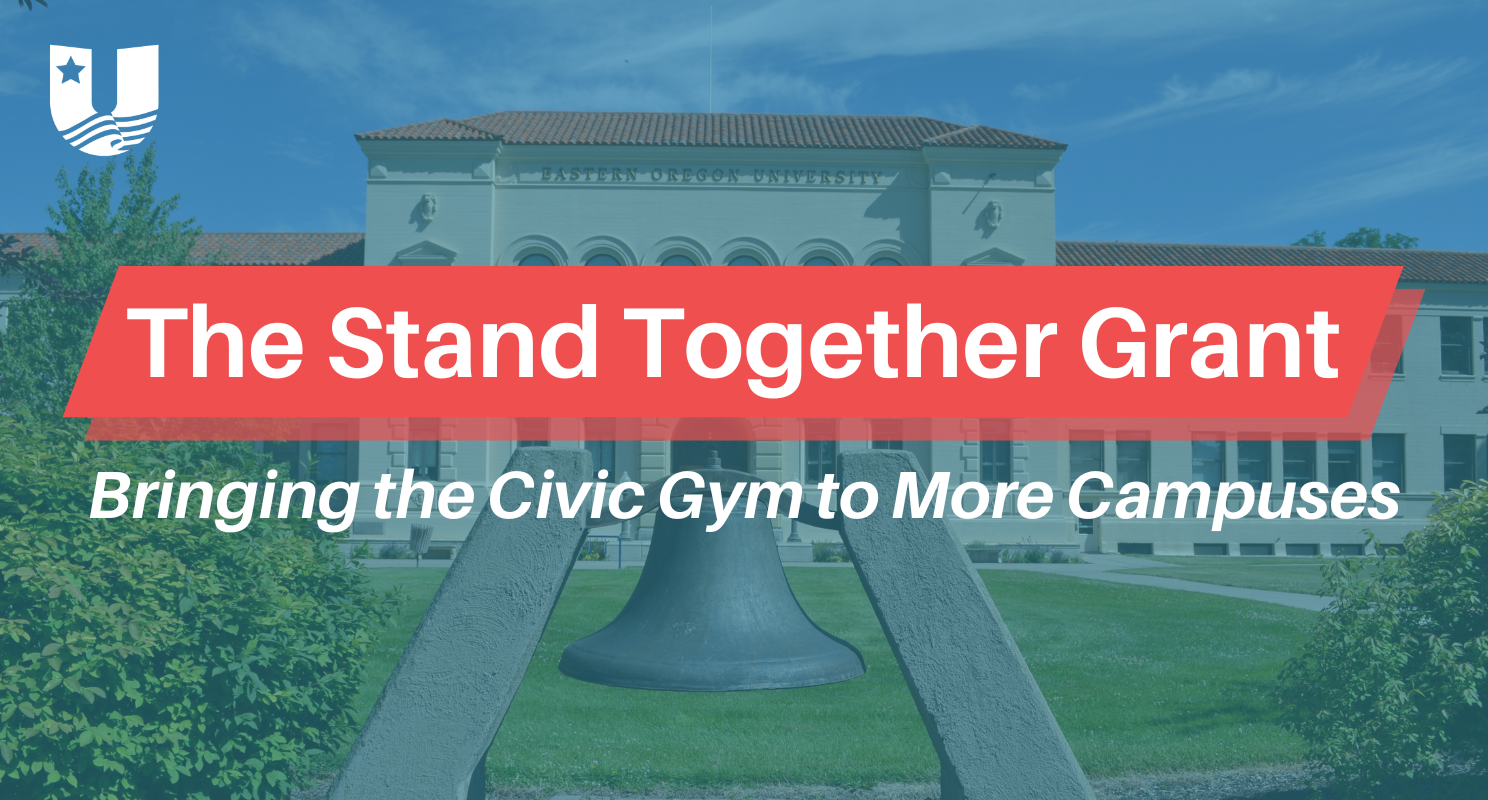
The Civic Gym gives students a place to practice the skills civic life runs on: holding a real conversation, sitting with hard questions, and collaborating on decisions that shape a community. The catch is that the campuses whose students stand to gain the most from that practice are often the ones with the least budget for programs that can help.
The Stand Together Grant is how we start to change that.
What the grant is
Stand Together is a national philanthropic community that backs organizations working on education, economic opportunity, health care, and civic life. Through a grant from Stand Together, we're covering or subsidizing Civic Gym subscription costs for 10 to 12 rural-serving and under-resourced institutions for the 2026–2027 academic year. For those campuses, the upfront cost is no longer a barrier between their students and the program.
How it will help
Covering the cost of running the Civic Gym is the start. The grant is built around a few goals:
- Build it into the curriculum. Covering the upfront costs of implementing the Civic Gym buys a campus time: a longer runway to weave the Civic Gym into its courses and build the internal case to fund it down the road. Some institutions may opt for multi-year subsidized subscriptions to give that process even more time.
- Move toward self-funding. We're aiming for half of the institutions that begin under the grant to move to a self-paid model for the 2027–2028 academic year, once they've seen what the Civic Gym does for their students.
- Grow beyond one educator. A program lasts when it's bigger than a single professor's enthusiasm for it. We want every participating institution to expand past one educator, so the Civic Gym becomes part of how the campus teaches rather than a one-person project.
Where things stand
Finding the right campuses takes a lot of conversations. So far we've reached out to more than 140 institutions, opened active conversations with 14, and confirmed our first 3.
The first three schools
Metropolitan State University of Denver. A public university in Denver serving roughly 13,000 students, where 57% are students of color and 57% are the first in their family to attend college. It's also a Hispanic-Serving Institution.
The Ohio State University at Marion. A public satellite campus in Marion County, Ohio, enrolling about 1,200 students, 37% of whom receive Pell Grants.
Eastern Oregon University. Known around the state as "Oregon's Rural University," this campus in La Grande enrolls around 3,000 students, 52% of whom receive Pell Grants.
.png)
Help us reach the next campus
This work is possible because of the support of Stand Together, and it grows through people who know where it's needed. If there's a professor, campus leader, or student group at a rural-serving or under-resourced college who should hear about the Civic Gym, we'd love an introduction.
a little bit about us

Unify America is a nonpartisan nonprofit on a mission to replace political fighting with problem-solving. We leverage technology and games to reduce political polarization and teach civic and problem-solving skills so Americans can work together to reach our shared goals. Founded in 2020 by Harry Nathan Gottlieb (founder of Jellyvision and Jackbox Games), Unify America builds interactive experiences to teach and master critical civic skills across cultural, political, racial, geographic, and religious differences.

You might also be interested in...
.png)
News & Announcements
Five Colleges Selected for First-of-its-Kind Effort to Connect Civic Learning to Workforce Readiness
A new Unify America pilot connects civic learning to the durable skills employers say new grads need.
.png)
Unify America Team
Sep 11, 2026
Sep 10, 2026

Campus & Higher Ed
Can Two Strangers Actually Have a Real Conversation About the Big Stuff?
Three students share what it's really like to talk politics with a stranger in the Civic Gym.

Layne Turci
Aug 27, 2026
Aug 27, 2026

Perspectives
American Ideals Day - A Reflection
A year of hope: from Akron's Civic Assembly to Civic Gym growth, ordinary people prove progress comes from staying in the conversation.

Harry Nathan Gottlieb
Aug 27, 2026
Jul 1, 2026


We use cookies to optimize our website and your experience with Unify America. But, like our democracy, you're in control. View our Privacy Policy for more information.

Privacy is important to us, so you have the option of disabling certain types of storage that may not be necessary for the basic functioning of the website. Blocking categories may impact your experience on the website. More information