.webp)

Back to all
What an Unlikely Mix of Americans

Harry Nathan Gottlieb
Apr 6, 2026
Jun 2, 2026


.png)
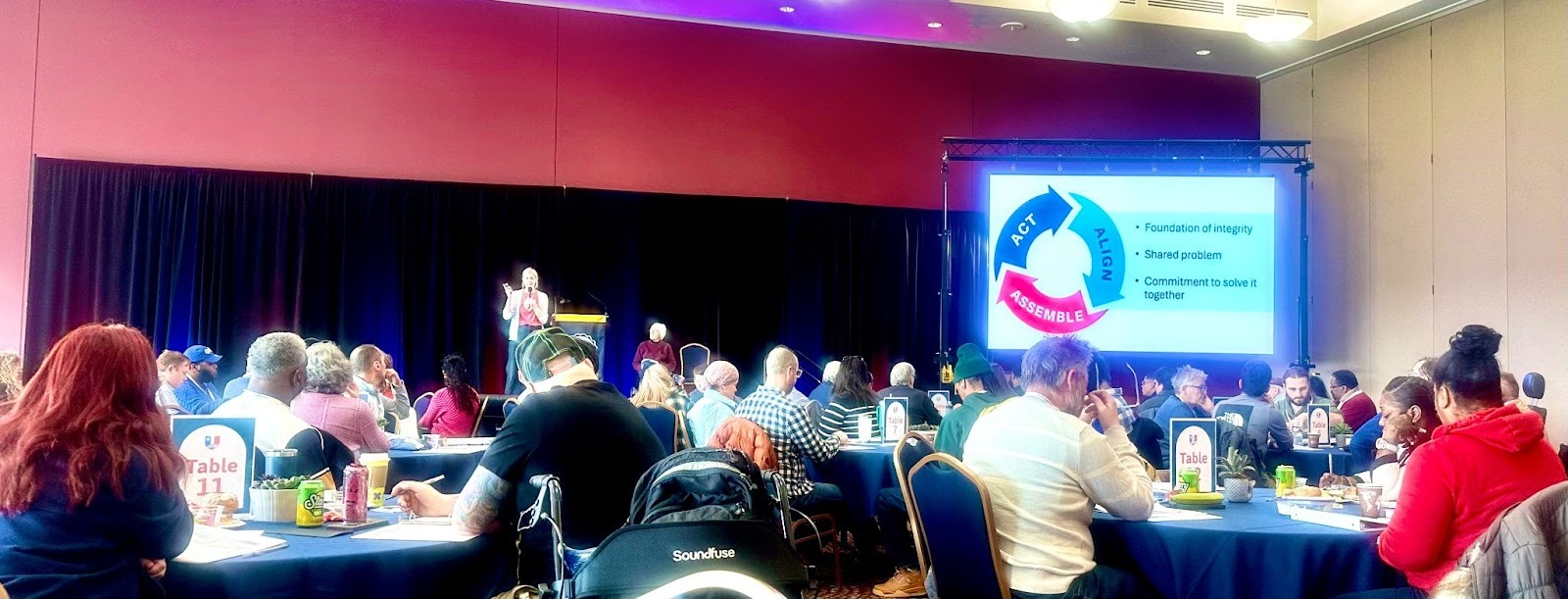
Step off the elevator on the third floor of the student union at the University of Akron, turn left, and push through the double doors. You will find yourself in a sun-drenched room with twenty-five-foot ceilings. And on certain days this Spring, you will also find a most unusual collection of people gathered in one place, participating together in a novel civic activity.
They’re not activists. Not advocates. Not the same dozen people who show up to every city council meeting to yell at officials. Look around this room and you'll see 80 year olds and 18 year olds. You’ll see people who vote for different political parties and a few who’ve given up on voting altogether. You’ll see people with graduate degrees and others who didn’t graduate high school. You’ll see sixty-five people, selected by lottery from 584 Akronites who raised their hands to participate.
Basically, you’ll see a miniature version of Akron.
You’re looking at a Civic Assembly, and here's what makes it unlike anything else in American political life: these very different people didn’t show up and kick things off by arguing.
They started by agreeing.
...
Problem-solving using the political process follows a predictable script. One side pushes their solution. The other side attacks it. The problem — the actual problem that real people are living with — gets lost somewhere in the noise of the conflict. The fight becomes the story, as if democracy itself is a battle between entrenched interests.
But that’s just one (not very effective) form of democracy: political democracy.
Political democracy is premised on the irrational assumption that we will be able to solve our public problems by fighting each other.
The superior form of democracy unfolding in Akron is called deliberative democracy.
Its starting point isn't one side’s solution to a problem. It's a shared goal. In Akron, the shared goal looks like this:
Every citizen delegate in that room on the third floor agreed to that goal before the first session began.
The mayor agreed to it, too — in writing, in a memorandum of understanding that commits him to publicly review every recommendation the assembly produces; to state what the city will implement and what it will not and why; and to provide public updates every six months for two and a half years.
The city council also officially embraced the shared goal — unanimously, by resolution, committing to a transparent review of recommendations and to passing the laws required to bring them to life.
The executive branch, the legislative branch, and the people — all in partnership. All starting from the same place: the outcome everyone wants to achieve.
Think of a civic assembly as a jury for problem-solving.
For the Akron assembly, researchers, think tanks, and individuals from the area and from across the country submitted 165 ideas for how to achieve the shared goal. A diverse team of eighteen local experts — from commercial real estate developers to affordable housing advocates to the city planning director — narrowed those 165 ideas to a dozen proposals.
The work of the citizen delegates in this assembly is to deliberate the pros and cons of each of those 12 proposals, build consensus around the ones worth pursuing, and provide guidance to the government about how to implement them.
Delegates were oriented on day one: your job is not to win a debate, it’s to help each other get smarter. To listen actively. To notice your biases, the ones we all have, that can quietly distort your judgment. To build collective wisdom so that everyone's final vote is as wise as possible.
Six more deliberative sessions remain.
And on May 14th, the assembly will take its final vote. A supermajority — no fewer than two-thirds of delegates — must agree on a set of recommendations for the process to move forward.
If it does, one week later, those recommendations will be presented to the government in a public ceremony.
This is not a focus group. This is not a survey. This is governance. The future of the People governing in partnership with elected leaders.
And it’s just the beginning.
...
This assembly is led by Unify Akron, an organization that will not dissolve when the assembly concludes. It will live on as a permanent institution — a civic infrastructure that runs future assemblies and serves as a hub for ongoing cooperation, weaving deliberative democracy into the fabric of how Akron works.
Dayton is next, with a civic assembly focused on healthcare, launching in May. Toledo's mayor indicated their city is ready to move, too. A new form of democracy is taking root in Ohio, city by city, and Unify America is building the playbook — the tools, the training, the system — to carry it across the country.
What's happening in Akron is proof that it's possible. You can put a room full of very different people together, give them good information, a shared goal, and a genuine process…and they’ll rise to the occasion.
Every time it works, it becomes harder to accept that it can't work everywhere.
That's the momentum we're riding. And we're just getting started.
Enjoyed this article?
Sign up for our newsletter to join the thousands of Americans who are making a difference, and then consider sharing it.
a little bit about us

Unify America is a nonpartisan nonprofit on a mission to replace political fighting with problem-solving. We leverage technology and games to reduce political polarization and teach civic and problem-solving skills so Americans can work together to reach our shared goals. Founded in 2020 by Harry Nathan Gottlieb (founder of Jellyvision and Jackbox Games), Unify America builds interactive experiences to teach and master critical civic skills across cultural, political, racial, geographic, and religious differences.

You might also be interested in...
.png)
News & Announcements
Five Colleges Selected for First-of-its-Kind Effort to Connect Civic Learning to Workforce Readiness
A new Unify America pilot connects civic learning to the durable skills employers say new grads need.
.png)
Unify America Team
Sep 11, 2026
Sep 10, 2026

Campus & Higher Ed
Can Two Strangers Actually Have a Real Conversation About the Big Stuff?
Three students share what it's really like to talk politics with a stranger in the Civic Gym.

Layne Turci
Aug 27, 2026
Aug 27, 2026

Perspectives
American Ideals Day - A Reflection
A year of hope: from Akron's Civic Assembly to Civic Gym growth, ordinary people prove progress comes from staying in the conversation.
Harry Nathan Gottlieb
Aug 27, 2026
Jul 1, 2026


We use cookies to optimize our website and your experience with Unify America. But, like our democracy, you're in control. View our Privacy Policy for more information.

Privacy is important to us, so you have the option of disabling certain types of storage that may not be necessary for the basic functioning of the website. Blocking categories may impact your experience on the website. More information